This post may include affiliate links.
Here’s how to make a Sazerac, the official cocktail of New Orleans! Cognac, whiskey and absinthe make up this famous drink that tastes like no other.

Here’s a boozy classic cocktail that’s one of the greats: the Sazerac! If you love spirit-forward drinks like the Old Fashioned, this one’s for you. Instead of just whiskey and sugar, this one’s got a surprise element: absinthe gives a black licorice finish to each sip.
This formerly outlawed liquor is now back in good graces (since 2007, at least!), and it’s a great reason to try this famous slow sipper. It’s the official drink of New Orleans and one of the oldest cocktails there is. Here’s my classic way to make it!
What’s a Sazerac?
The Sazerac is a low ball cocktail made with Cognac or rye whiskey, absinthe, and Peychaud’s bitters. The exact history of the drink is murky, but it was invented in New Orleans in the mid-1800’s. Some sources state the Sazerac was invented as early as 1838 by apothecary Antoine Peychaud. Others claim that the owner of the Sazerac Coffee House, Aaron Bird, created the drink in the 1850’s.
The name comes from the type of Cognac it was originally made with, Sazerac-de-Forge et Fils. Later rye whiskey was used in place of the Cognac, and cocktails today use either or both.
What Does It Taste Like?
A Sazerac is spirit-forward and boozy, with warm oak notes from the Cognac and rye, herbal notes Peychaud’s bitters, and a black-licorice finish from the absinthe.
If you love spirit-forward drink like the Old Fashioned, you’ll enjoy this one. I personally prefer more of a balanced sweet tart drink, so I would choose a Corpse Reviver over this one if we’re talking absinthe cocktails.
Ingredients You’ll Need
This cocktail is on the list of International Bartender Association’s IBA official cocktails, meaning that it has an “official” definition. The ingredients in a Sazerac are:
- Cognac and/or rye whiskey: This makes a spirit-forward backbone to the drink (see more below)
- Absinthe: For the aromatic anise notes
- Peychaud’s bitters: These bitters are sweeter and more floral than Angostura (though Angostura works as a sub
- Sugar cube: muddled in to balance the spirits, like in an Old Fashioned
- Lemon peel: expressed over the top to finish
Cognac, Rye Whiskey, or Both?
The first Sazerac cocktails were made with Cognac: a brand name called Sazerac. Around the 1870’s, rye whiskey replaced the Cognac because of a pest that devastated vineyards in France. Today it can be made with either liquor: or both! The official IBA cocktail version uses rye whiskey, but many sources claim it should be made with Cognac.
For the best flavor, use both! I had Cognac on hand from making a Sidecar and other Cognac cocktails, and I love the flavor combined with the spicy rye whiskey. (Plus, Cognac is the most traditional.) But if all you have is rye whiskey, just substitute it for the Cognac! You can also use bourbon to make a Bourbon Sazerac.

A Word on Absinthe (and Herbsaint)
Absinthe is a green anise-flavored spirit made from botanicals: wormwood, anise, fennel and other herbs. It was actually illegal in the US from 1912 to 2007 because people that it was hallucinogenic. Scientists today have determined that absinthe is perfectly safe consumed in moderation, and that absinthe is no more harmful than any other alcohol (read about absinthe myths here).
For decades, New Orleans bartenders used Herbsaint (a locally made anise liqueur) as a stand-in during the ban, and it’s still a substitute today. Pastis or Pernod work well too.
If you do grab a bottle of absinthe, you can use it in classic absinthe cocktails like Death in the Afternoon, La Louisiane and my favorite, the Corpse Reviver!
Do You Need Peychaud’s Bitters?
Another specialty ingredient you need for the Sazerac; Peychaud’s bitters! Bitters are liquors made with herbs and spices that add intrigue and complexity to the flavor of. Peychaud’s bitters are unique, but they’re worth finding for the Sazerac. The flavor is a little sweeter than Angostura bitters, the most popular type of bitters you might already have on hand. The flavor has hints of anise and mint.
Can you substitute Angostura bitters in a Sazerac? Well, purists claim the Sazerac must be made with Peychaud’s bitters. But if all you have is Angostura, you can use that too! Some people even like to use both Peychaud’s and Angostura (like in a Vieux Carre).

How to Make a Sazerac Cocktail
Most bartenders make the Sazerac in a special way: with 2 chilled low ball glasses. One glass gets an absinthe rinse, and the other is used to stir and chill everything else before straining it back into the rinsed glass.
After extensive taste testing, I’ve found that for the home bartender, this isn’t really necessary. While a purist might insist on it, I found it was just as good simply stirred with absinthe in a mixing glass. Here’s what to do:
- Stir together all ingredients in a cocktail mixing glass. Why not a shaker like most cocktails? Shaking in a cocktail shaker dilutes the drink: and for this one, you want it to be straight booze.
- Don’t have one? Use any glass or container you like to mix the drink, then strain it into the serving glass. If you want to look like someone who knows their cocktails, grab yourself a cocktail mixing glass.
Related New Orleans Drinks and Cocktails
The Sazerac is the official New Orleans cocktail, according to a decision by the Louisiana Legislature in 2008. But there are plenty of other famous drinks associated with this city! Here are a few more New Orleans cocktails you should try, and the first two are related drinks to the Sazerac:
- La Louisiane: an absinthe, rye, and vermouth cocktail that I personally think improves on the original!
- Vieux Carre: a rich 1930s classic with rye, Cognac, and vermouth
- Milk Punch: cold and creamy, it’s a classic at New Orleans brunch
- Pimm’s Cup: bright and bubbly, it’s a patio staple

When to Serve a Sazerac
The Sazerac is a boozy cocktail that’s great for Cognac, rye, and Old Fashioned lovers. It’s perfect for sipping as a:
- Happy hour drink
- Dinner party drink
- Late night drinks drink
- Guys or girls night drink
- Cocktail hour drink
Sazerac Cocktail
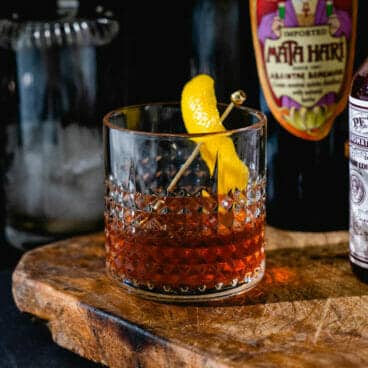
Here’s how to make a Sazerac, the official cocktail of New Orleans! Cognac, whiskey and absinthe make up this famous drink that tastes like no other.
- Prep Time: 5 minutes
- Cook Time: 0 minutes
- Total Time: 5 minutes
- Yield: 1 drink 1x
- Category: Drink
- Method: Stirred
- Cuisine: American
- Diet: Dairy-Free, Gluten-Free, Vegan, Vegetarian
Ingredients
- 3–4 dashes Peychaud’s bitters
- 1 sugar cube
- 1 teaspoon absinthe
- 1 ½ ounces (3 tablespoons) Cognac
- 1 ounce (2 tablespoons) rye whiskey
- Lemon twist
Instructions
- In a mixing glass, add the sugar cube and coat it with the bitters. Muddle the sugar cube with a cocktail muddler or wooden spoon until mostly dissolved. Add the Cognac, rye whiskey and absinthe and fill the mixing glass with a handful of ice.
- Stir until cold. Strain the drink into a chilled low ball glass.
- Use a knife to remove a 1″ wide strip of the lemon peel. Squeeze the lemon peel into the drink to release the oils. Gently run the peel around the edge of the glass, then place it in the glass and serve.