
This easy vegetable broth recipe makes carrots, celery, onion and garlic into a savory homemade broth in about 1 hour. Use it in soups, risotto, and more!
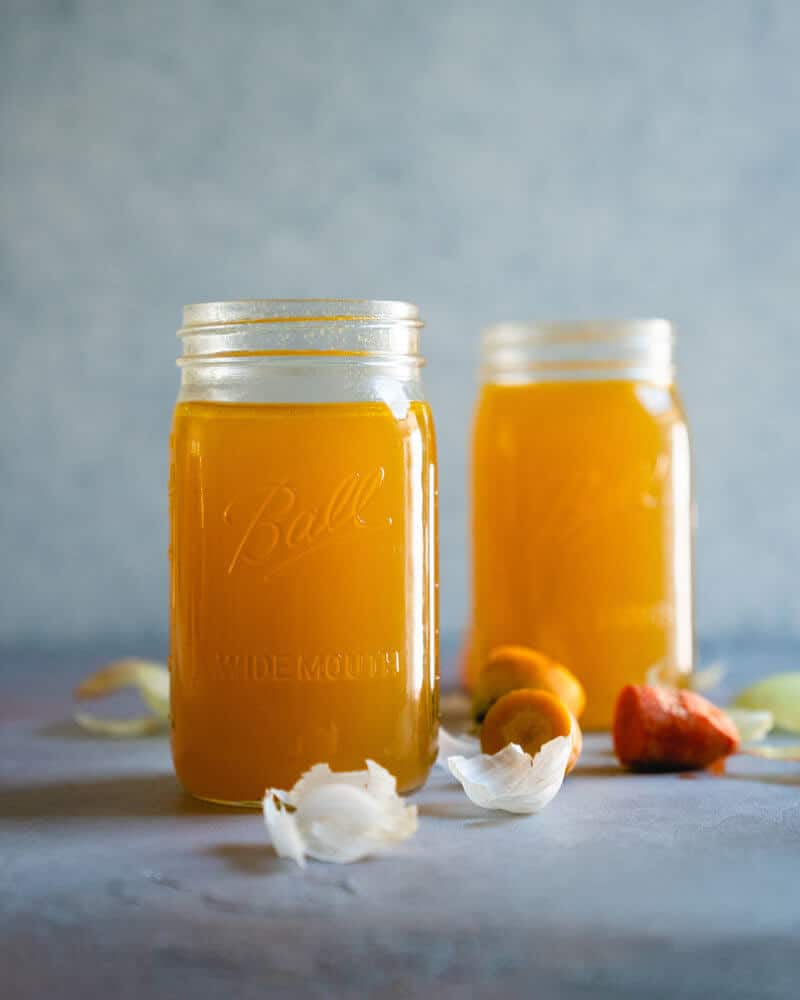
Homemade vegetable broth is so easy to make: I’ve discovered it’s one of those things that requires a little forethought but is absolutely worth the extra planning! Here’s the recipe I’ve been making for years (and readers have consistently loved).
Not only does homemade vegetable broth taste better than the store-bought stuff, but you have more control over the amount of salt and there’s no additive ingredients. Once the vegetable stock is made, it will last 4 to 5 days in the fridge, or up to 6 months in the freezer. Here’s how to make it!
5 Star Reader Reviews
⭐⭐⭐⭐⭐ “This was freakin’ delicious!! Why have I not made this before?! I made healthy vegetable stew with it and it was soooo good.” -Lindy
⭐⭐⭐⭐⭐ “I use vegetable broth often and usually purchase it only when it’s buy one get one free, but no longer! This recipe was easy, delicious and allows me to control my sodium intake; unlike store bought brands. Thank you!” -Brenda

Ingredients For Homemade Vegetable Broth
You really can’t go wrong with this vegetable broth recipe. It uses veggies that might be on hand in your pantry and fridge: carrots, celery, garlic, potatoes, and so forth. You also can throw in any fresh herbs you have around! It’s a great idea for minimizing food waste in your kitchen.
Using other veggies you have on hand like mushrooms, peppers, and potatoes works too. This veggie broth is a great alternative for recipes that call for chicken or beef broth. I use vegetable stock or broth in most of my easy soup recipes!
What Not to Put in Vegetable Broth
Keep in mind, not every vegetable can go into veggie broth! Some vegetables can make it taste bitter, or turn it cloudy or an odd color:
- Cruciferous vegetables: Broccoli, cabbage, cauliflower, Brussels sprouts, and kale can make the broth taste bitter
- Starchy vegetables: Potatoes and winter squash can make a broth cloudy.
- Beets: These will turn your broth pink! (Only do this if you want pink soup.)
- Strong flavors in large amounts: Bell peppers and fennel work in small quantities.
- Anything past its prime: Do not use anything slimy, moldy, or questionable!
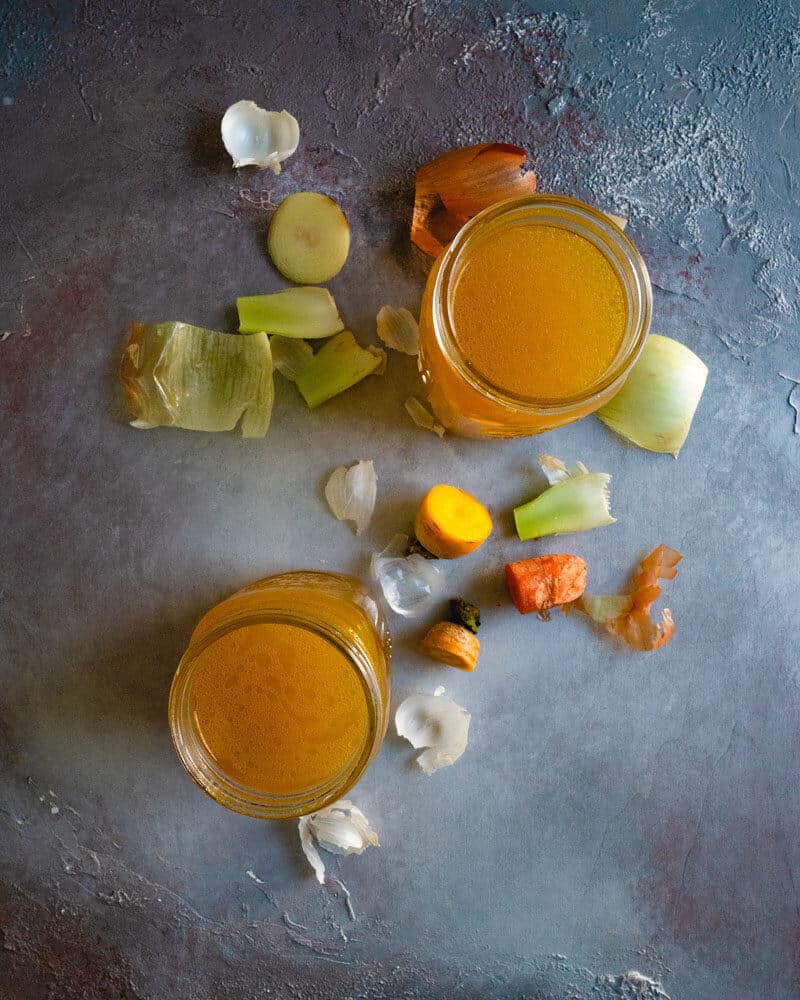
How To Make Vegetable Broth
Making homemade vegetable broth is as easy as throwing chopped veggies into a pot and boiling them (yes, really!). The basic steps of making vegetable broth at home are as follows (see the recipe below for quantities):
- Chop the vegetables into large chunks. Don’t bother peeling them, as you’ll be straining everything later. Plus, the skins contain a lot of nutrients and flavor!
- Add the vegetables to a stockpot or Dutch oven and sauté for 5 minutes. This will add extra flavor to the broth without any extra effort on your part.
- Add in the water and bring the mixture to a boil. Once boiling, cover the pot and let it simmer for at least 45 minutes to allow the vegetables to impart as much of their flavor into the broth as possible.
- Strain the vegetable broth and use immediately or freeze for later use. If freezing, let the broth come to room temperature before putting it into the freezer.
Making homemade vegetable broth couldn’t be easier. I hope you enjoy this recipe as much as I do!
Also in a Dutch oven: Try my 12 Easy Dutch Oven Recipes.

Ways To Use It
There are so many ways you can use this homemade vegetable broth: here are a few of my favorites:
- Soups like Classic Bean Soup, Kale Soup, Vegetarian Tortilla Soup, or Wild Rice Soup
- Risottos like Butternut Squash Risotto or Parmesan Truffle Risotto
- Lentils like Seasoned Brown Lentils
- Chowders like Creamy Corn Chowder
- Ramen like my Easy Vegetarian Ramen or Tofu Ramen
Storage & Freezing Instructions
Homemade vegetable broth stores 4 to 5 days in the refrigerator. You can also store it frozen for up to 6 months.
To freeze it, allow the broth to cool. Place it in a container with about 1-inch of space at the top, to allow for the liquid expanding when it freezes. For small amounts, you can also freeze the broth in an ice cube tray.
Dietary Notes
This vegetable broth recipe is vegetarian, gluten-free, vegan, plant-based, and dairy-free.

Easy Vegetable Broth
This easy vegetable broth recipe makes carrots, celery, onion and garlic into a savory homemade broth in about 1 hour. Use it in soups, risotto, and more!
- Prep Time: 15 minutes
- Cook Time: 45 minutes
- Total Time: 1 hour
- Yield: 8 cups 1x
- Category: Soup
- Method: Stovetop
- Cuisine: American
- Diet: Dairy-Free, Gluten-Free, Mediterranean Diet, Vegan, Vegetarian
Ingredients
- 4 carrots
- 3 ribs celery
- 1 onion
- 5 cloves garlic
- 3 tablespoons olive oil
- 1 tablespoon kosher salt
- ½ tablespoon whole peppercorns
- 10 cups of water
Instructions
- Wash all of the vegetables. Don’t bother peeling them. Cut the carrots, celery, and onion into a large dice. Smash the garlic cloves and peel them. *If you have leftover fresh herbs on hand, you can throw these in too!
- In a stock pot or Dutch oven, heat the olive oil. Add the vegetables and saute for 5 minutes. Then add 10 cups of water. Stir in 1 tablespoon kosher salt and ½ tablespoon whole peppercorns.
- Bring the vegetable broth to a boil. Then reduce to a gentle simmer and cover the pot. Simmer for 45 minutes; make sure that the simmer is gentle so that not too much liquid boils off.
- Strain the vegetable broth into jars with lids. If the broth amount does not total 8 cups, add water to even it out. Use immediately, store refrigerated for 4 to 5 days, or freeze for 6 months. (If freezing, let the vegetable broth come to room temperature before putting it into the freezer. Make sure there is enough room in the container for the broth to expand when frozen.)




Can I freeze it in glass jars?
Just make sure you leave it room to expand.
I love this recipe! Others may have also mentioned it, but I prefer using fresh vegetables over frozen scraps, a process I somehow never took a liking to, to make an easy and fresh vegetable broth, which is delicious too.
So do you peel the garlic cloves? I found a container of button mushrooms I forgot about in back of fridge, kind of slimy & discolored? Can I use these or throw them out? Thank you!
We do peel the garlic. I would pass on the mushrooms once they’ve gone slimy.
hi.
thanks for this recipe.
my question, as I am based in Europe and not familiar with “cup”:
how much ml (European way for volumes/liquids) are 10 cups ?
I found some converters, but they give different results.
thanks for a response.
s.
Hi! It would be 2.3 liters.
I use vegetable broth often and usually purchase it only when it’s buy one get one free, but no longer! This recipe was easy, delicious and allows me to control my sodium intake; unlike store bought brands. Thank you acoupleofcooks.com!!!
You’re welcome!
I recently had a heart attack (second) and am having to do as low sodium as I can. I’ve noticed, or maybe, missed it but none of your recipes show the amount of sodium in the nutritional facts. Can I ask why as to many of us trying to go more vegetarian, sodium is a big deal. Thank you, and I just bought your cookbook. :-)
Hi! Thanks for reading (and getting the cookbook!) We omit the sodium because many ingredients we use such as beans, soy sauce or broth can have vastly different amounts and we don’t want to give false information. Even different brands of kosher salt can vary. 1 teaspoon of Morton kosher salt has 1920 mg of sodium if that is helpful.