
This post may include affiliate links.
This easy focaccia bread recipe has crispy edges, a fluffy crumb, and a rich olive oil flavor. Simple ingredients, flexible timing, and big Italian flavor!
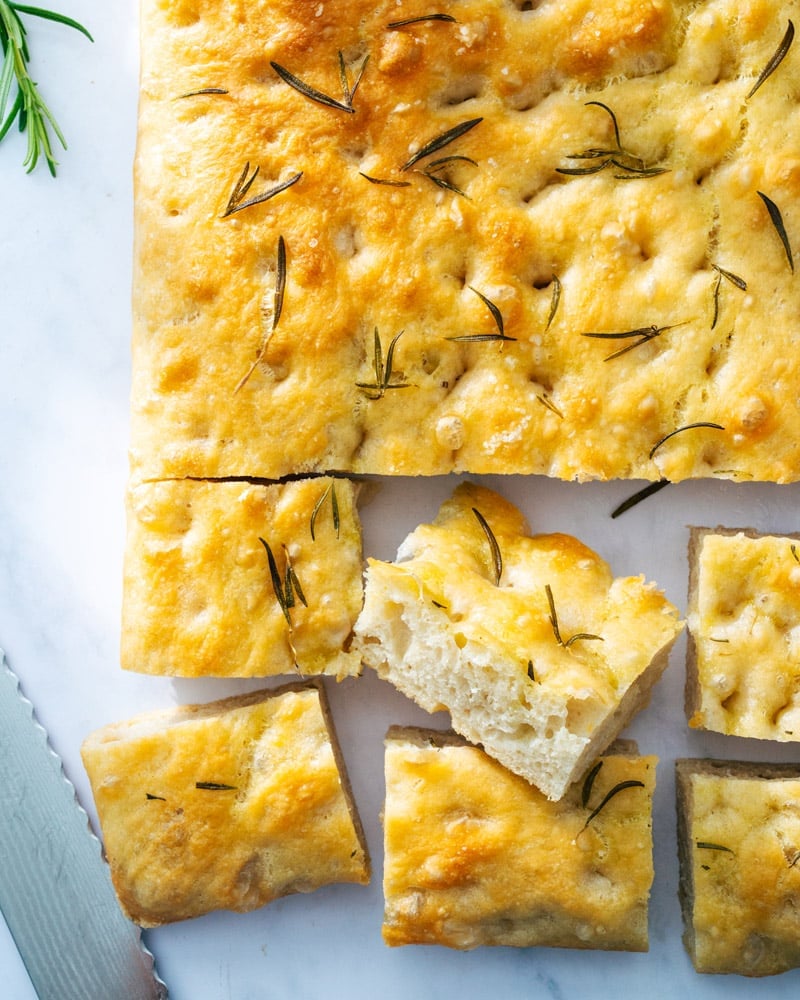
The first time I pulled a pan of homemade focaccia out of my oven, I couldn’t believe how something this good could come from such simple ingredients! This bread comes out thick and airy, crispy on the outside with pillowy air pockets on the interior, with flavor notes of salt, rosemary and olive oil.
My husband Alex and I developed this bread recipe together, and it quickly became one of our favorite easy bread recipes because you can get incredible flavor with minimal effort. It has a high hydration dough that creates beautiful air bubbles, and a good amount of olive oil to give it a rich flavor. The best part is you need minimal equipment and no baking experience!
Why You’ll Love This Recipe
If a focaccia recipe is not formulated correctly, it can come out very dense, with no holes in the crumb, thin or dry, or fluffy and soft like a roll. Here’s why you’ll love this recipe:
- The bread is thick and crisp on the outside, perfect for eating plain or slicing in half as focaccia sandwiches.
- It has a beautiful airy crumb, which comes from an overnight rise.
- It’s got a developed, well-seasoned flavor that tastes like it’s from an Italian bakery!
- You need minimal hands-on time: Just 5 minutes to mix, 5 minutes to shape, and you’re done with active work
Want a focaccia that you can bake the same day? Try my new Quick Focaccia Bread recipe!
5-Star Reader Reviews
⭐⭐⭐⭐⭐ “We absolutely love this recipe! It is so easy and so tasty. Today, I made it as a half-batch in an 8×8 pan. I use a rosemary sea salt in the brine when I don’t have fresh rosemary.” –Lisa D.
⭐⭐⭐⭐⭐ “This bread was perfection! My family loved it! I’ve tried several focaccia recipes, and this by far is the best. I cooked it in a cast iron skillet – so pretty when it was turned out.” –Margie B.

What You’ll Need
One of the great things about homemade focaccia? You need only a few ingredients and minimal bread-making tools. Many of my bread recipes require a Dutch oven, bread basket, special knife for scoring, and other equipment. Here’s what you’ll need for this recipe:
- Bread flour: Bread flour has a higher protein content than all-purpose flour, which makes for a lighter, airier texture. It’s worth finding for this recipe!
- Active dry yeast: Use active dry yeast, not instant. You can store it in the freezer between uses.
- Olive oil and salt: The oil brings a rich flavor and crispy exterior.
- Fresh rosemary: Fresh rosemary is traditional in Italian baking of focaccia and it adds just the right herbaceous scent to the fresh bread.
- 9 x 13″ baking dish: This is used for baking the bread.
- Kitchen scale (optional): While it’s optional, I highly recommend weighing the ingredients for best results when you’re baking
- Pizza stone (optional): It helps to heat the bread quicker and make an airier dough. Here’s the pizza stone I use. (You can also use it for these pizza recipes and other breads, so it’s a great investment.)
How to Make Focaccia Bread
Focaccia bread is an Italian flatbread baked in a sheet pan and flavored with olive oil. A good focaccia should be thick and airy, with those signature air pockets in the crumb (interior texture). It’s similar to pizza dough but is made using a bread flour and more yeast, which makes it taller and fluffier.
Focaccia is one of the easiest bread recipes I have, but you do need to think ahead! Here’s an overview of the steps required (or jump to the recipe to get started):
- Mix the dough (5 minutes). Mix the ingredients in a bowl: the dough will be wet and sticky, which is what you want.
- Rest overnight (12 to 16 hours). Cover the bowl tightly with plastic wrap or place it in a large zip-top bag. Rest at room temperature overnight.
- Shape in the baking pan (5 minutes). Drizzle olive oil into a 9×13 inch metal baking pan. Add the dough to the pan and with oiled hands, gently press and stretch the dough toward the corners of the pan. Be gentle so you don’t deflate the air bubbles.
- Second rise (45 minutes). Cover with plastic and rest at room temperature. Meanwhile, preheat your oven to 425°F.
- Create the brine and dimple (5 minutes). Mix the brine ingredients: olive oil, water, and kosher salt. Pour this mixture over the dough. Then use your fingertips to press into the dough and create dimples across the entire surface of the dough.
- Bake until golden brown (35 minutes). Bake for 30-35 minutes, until the top is deeply golden brown and the edges are crispy.
- Step 8: Cool (45 minutes). This is the hardest part! Let the focaccia cool completely in the pan before slicing. Cooling allows the structure to set and makes slicing much easier.

Timing Options: Same-Day or Overnight
Overnight (Preferred):
This gives you the best flavor and most open crumb. I usually mix the dough around 9:00 pm, let it rise overnight on the counter, then shape and bake around 1:00 pm the next day. The long fermentation at room temperature develops depth of flavor and makes a more complex flavor than quick-rise methods.
Same-Day (When Time is Short):
Mix the dough in the morning, let it rise for 2-3 hours at room temperature, then shape, proof for 45 minutes, and bake. It won’t have quite the depth of flavor of the overnight version, but it’s still better than store-bought and easy for same-day bread.
Toppings, Add-Ins, & Variations
Topping Variations
You can add many toppings to focaccia bread in addition to the classic rosemary and sea salt. Here are a few ideas (all added after dimpling, before baking):
- Cherry tomatoes
- Caramelized onions
- Sliced olives
- Sun-dried tomatoes
- Thinly sliced red onion rings
- Grated Parmesan cheese
Pan Variations
You can also change up the pan sizes:
- Sheet pan focaccia: Use a rimmed baking sheet for a thinner, crispier focaccia
- Cast iron skillet: Makes a round focaccia with especially crispy edges
- 8×8 pan: Use half the recipe for a smaller batch (perfect for 2-3 people)

Serving Ideas
That beautiful loaf of focaccia bread will make your kitchen smell like a bakery. If you can resist, wait until it’s fully cool to take a taste. However, this type of bread won’t suffer if you try to sneak a piece when it’s warm (which is a no-no with sourdough bread). Focaccia works served on its own as a side for lunch, dinner, or soups, or sliced for sandwiches. Here are a few ways to serve focaccia bread:
- As a side for Italian meals
- As a side for soup
- Sliced on a cheese board or antipasto platter
- As an Italian appetizer
- Sliced for a sandwich like a focaccia sandwich, caprese sandwich, Italian eggplant sandwich or salmon sandwich
- For holiday appetizers or sides like Thanksgiving or Christmas
Storing & Reheating Leftovers
You can store homemade focaccia bread for up to 3 days in a sealed plastic bag with excess air squeezed out, or in a sealed container. It’s great room temperature or you can reheat it in a 375°F oven until warm.
Focaccia freezes for up to 3 months. Let it cool completely, then wrap tightly in plastic wrap followed by aluminum foil. Freeze in slices or as a whole loaf. To thaw, leave it at room temperature for 2-3 hours, then bake in a 350°F oven for 10 minutes.
Dietary Notes
This focaccia recipe is vegetarian, vegan, plant-based, and dairy-free.
Frequently Asked Questions
Focaccia is an Italian flatbread with a high olive oil content, dimpled surface, and airy crumb structure. It uses high hydration (lots of water relative to flour) which creates large, irregular air bubbles throughout. The generous olive oil both in the dough and on top gives focaccia its signature rich flavor and crispy exterior. The dimpling technique creates pockets that fill with olive oil and seasonings, making every bite flavorful and textured.
The secret to great focaccia comes down to three things: high hydration dough, generous olive oil, and proper fermentation time. High hydration (a wet, sticky dough) creates the air pockets and light texture. Good quality olive oil provides the rich flavor that makes focaccia special. Finally, giving the dough ample rise time (12-16 hours for overnight, or at least 2-3 hours for same-day) is important for the best fluffy texture
For the first rise, use 12-16 hours at room temperature. The second rise after shaping should be about 45 minutes. If focaccia over-proofs, the dough can become too relaxed, resulting in a flatter loaf with less height. Over-proofed dough looks very puffy but deflates when touched. If your dough over-proofs slightly, it’s usually still fine to bake: just handle it gently.
Yes! Sourdough focaccia adds wonderful tangy flavor. Go to this Sourdough Focaccia recipe. I also have a full Sourdough Bread Recipe if you want to explore sourdough baking further.
Use high-quality extra virgin olive oil. You can also add fresh or dried herbs to the dough itself, not just on top. Another idea is to brush the baked focaccia with garlic-infused olive oil while it’s still hot. You can add Parmesan cheese sprinkled on top, or Incorporate sun-dried tomatoes, olives, or caramelized onions into the dough.
Focaccia Bread Recipe
This easy focaccia bread recipe has crispy edges, a fluffy crumb, and a rich olive oil flavor. Simple ingredients, flexible timing, and big Italian flavor!
- Prep Time: 12 hours
- Cook Time: 35 minutes
- Total Time: 12 hours 35 minutes
- Yield: 18 1x
- Category: Bread
- Method: Baked
- Cuisine: Italian
- Diet: Vegan
Ingredients
For the bread
- 630 grams (4 ½ cups) bread flour
- 1 ½ teaspoons active dry yeast
- 2 teaspoons kosher salt
- 532 ml (2 ¼ cups) warm water
- 1 ½ tablespoons olive oil
For the brine
- 2 tablespoons olive oil
- 1 tablespoon water
- 1 teaspoon kosher salt
For topping
- Leaves from 2 rosemary sprigs
Instructions
- In a large bowl, stir together the flour, yeast and kosher salt. Add the warm water and 1 ½ tablespoons olive oil and stir with a wooden spoon until sticky dough is formed. With wet hands, lift the bottom of the dough and wrap it over the top a few times, folding the dough to make a ball and to ensure all of the flour has been incorporated. Place the dough back in the bowl and cover the bowl tightly with plastic wrap or place in a large zip-top bag.
- Proof overnight at room temperature, preferably 12 to 16 hours. The dough will rise and double in size, and then collapse. (For example, we like to mix at 9:00 pm and start the baking process at 1:00 pm the next day.)
- After the rise, add a small drizzle of olive oil into a 9″ x 13″ metal baking pan and use your hands to spread it across the bottom. With your oiled hands, turn the dough into the baking pan and gently press and stretch the dough so that it is evenly distributed across the pan (take care not to smash all of the air out of the dough). It may take several times of stretching it out to reach the corners. Cover the pan with plastic wrap or a large zip-top bag and rest for 45 minutes.
- Preheat the oven to 425 degrees Fahrenheit with a pizza stone inside. You can still bake without the pizza stone, but it will yield an airier dough.
- In a small bowl, stir together the brine ingredients.
- Pour the brine over the puffy dough and lightly press your fingers into the dough, all the way across, to dimple the dough. Sprinkle with rosemary leaves.
- Bake immediately: place the pan on the pizza stone and bake for 30 to 35 minutes until golden brown on top. Cool completely before cutting. Store up to 3 days in a sealed plastic bag with excess air squeezed out or a sealed container.
Notes
Freezing notes: Focaccia freezes for up to 3 months. Let it cool completely, then wrap tightly in plastic wrap followed by aluminum foil. Freeze in slices or as a whole loaf. To thaw, leave it at room temperature for 2-3 hours, then bake in a 350°F oven for 10 minutes.
Variations and add ins: Try topping the dough with sliced cherry tomatoes, caramelized onions, sundried tomatoes, or Parmesan cheese.



If I’m unable to work with the dough within the 12-16 hour window, do you think 6 hours or 20 hours would yield the best results? Which is the less-bad option, haha!??
20 is better!
Thank you!
We absolutely love this recipe! It is so easy and so tasty. Today I made it as a half batch in an 8×8 pan. I use a rosemary sea salt in the brine when I don’t have fresh rosemary.
Your focaccia bread recipe does not appear to state how much bread it makes. Also the scale button on this changes the flour in grams but does not change it in cups.
Thank you for the note! The recipe is for one 9*13 loaf.
Hello,
Just discovered your recipes and looking forward to trying them at Christmas!
Question about the Focaccia Bread – should I use 4.5 or 5.25 cups of bread flour?
Happy Holidays!
Christine
4 1/2 cups unsifted.
This bread was perfection! My family loved it! I’ve tried several focaccia recipes and this by far is the best. I cooked it in a cast iron skillet – so pretty when it was turned out. Have you ever tried a gluten free version?
We don’t have a gluten free version, sorry. So glad you enjoyed!
Just made this to have for dinner tonight and it looks great! Still cooling but looking forward to it. I got around the glass pan thing by putting my racks close together with the stone on the lower one and the glass pan on the one above. Only an inch or so space but enough for the pan not to crack …
I’ve made many of your recipes and my family really likes them, thanks for all that you do!
Great idea! Glad you enjoyed.
It was really, really good, particularly with salami and an aged provolone but … I’m saving half of it (in the freezer, pre-chopped) to add to my holiday dressing … should be great and might even make a second to serve as an appetizer (only four of us here so don’t need a whole bunch.) Thanks!
I usually weigh my flour but the weight listed here (630 g) is 5.25 cups, not 4.5 cups as stated. Could you let me know which it correct? Or maybe you’re using a different brand of flour? I’m using King Arthur bread flour. Thanks!
Hi! We are using 140g per cup. Thank you!
Before I embark on making what looks like a fantastic bread, please clarify, refrigerate or room temp overnight rise? At one point, there is “Has a beautiful airy crumb, which comes from an overnight rise in the refrigerator”. At another, “Proof overnight at room temperature, preferably 12 to 16 hours.” Also, the only 9″ x 13″ baking ‘pans’ I have are Pyrex. I don’t think a glass baking dish could be placed on the pizza stone. Your thoughts? What type of baking pan do you use for this? Many thanks in advance for your feedback. Your recipes are always delicious!
Great questions! The refrigerator statement was a typo — we’ve removed that! It is a rise at room temperature. Great point on the glass — we updated the recipe to call for a metal 9 x 13 pan. We’d either get a metal 9 x 13 or just bake without the pizza stone in Pyrex. Thank you so much for this comment!
Your focaccia recipe says gluten free but the recipe calls for bread flour not gluten free bread flour (if there is such a thing). It looks delicious.
Good point, that was a mistake! We’ve removed it. Thank you!
Didn’t know it was so easy to cook focaccia! Will give it a go this weekend!